


Description
"Taken as a trilogy, consent not to be a single being is a monumental accomplishment: a brilliant theoretical intervention that might be best described as a powerful case for blackness as a category of analysis."-Brent Hayes Edwards, author of Epistrophies: Jazz and the Literary Imagination
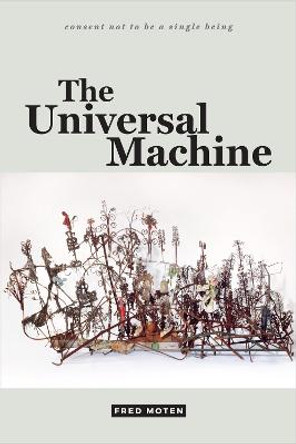
In The Universal Machine-the concluding volume to his landmark trilogy consent not to be a single being-Fred Moten presents a suite of three essays on Emmanuel Levinas, Hannah Arendt, and Frantz Fanon, in which he explores questions of freedom, capture, and selfhood. In trademark style, Moten considers these thinkers alongside artists and musicians such as William Kentridge and Curtis Mayfield while interrogating the relation between blackness and phenomenology. Whether using Levinas's idea of escape in unintended ways, examining Arendt's antiblackness through Mayfield's virtuosic falsetto and Anthony Braxton's musical language, or showing how Fanon's form of phenomenology enables black social life, Moten formulates blackness as a way of being in the world that evades regulation. Throughout The Universal Machine-and the trilogy as a whole-Moten's theorizations of blackness will have a lasting and profound impact.
About the Author
Fred Moten is Professor of Performance Studies at New York University and the author of Black and Blur and Stolen Life, both also published by Duke University Press, and In the Break: The Aesthetics of the Black Radical Tradition.
Reviews
"It's this spirit of the collective effort of study and exchange and resonance, the effort to keep the channels open and keep listening, that has made Moten (or, maybe, 'Moten/s') such a celebrated thinker. At the end of sentences like these, you want to say something like Amen." - Jess Row (Bookforum) "At a time when both theory and criticism are frequently and convincingly attacked as exhausted forms, Moten's trilogy has reinvented both. . . . In its mixture of theoretical complexity and disarming directness, Moten's beautifully written trilogy offers the sheer pleasure of art." - Lidija Haas (Vulture) "2018 must go down for me as the year of Fred Moten's trilogy: Black and Blur, Stolen Life, and The Universal Machine. You could say they're essays about art, philosophy, blackness, and the refusal of social death, but I think of them more as a fractal universe forever inviting immersion and exploration, a living force now inhabiting my bookshelf." - Maggie Nelson (Bookforum) "My favorite book(s) of 2018 are the three volumes of Fred Moten's consent not to be a single being, individually titled Black and Blur, Stolen Life, and The Universal Machine. In this collection of essays stretching back fifteen years, Moten challenges the reader to imagine a radically interconnected aesthetic and political sphere that stretches from Glenn Gould to Fanon to Kant to Theaster Gates, sometimes in the space of a single sentence. This trilogy is one of the great intellectual adventures of our era." - Jess Row (Bookforum) "consent not to be a single being, titled after a phrase of Edouard Glissant's, ranges across an impressive number of disciplines: black studies, performance studies, aesthetics, phenomenology, ontology, ethnomusicology, jazz history, comparative literature, critical theory, etc. Without announcing its intervention as interdisciplinary-Moten deftly renders discipline beside the point. . . . Taken together, the series amounts to a powerful argument for black study-as an analytic, an impetus, a mode, the collective shout from a radical vista, whose bellow requires nothing less than 'passionate response' (Moten 2003)." - Mimi Howard (boundary 2)
Book Information
ISBN 9780822370468
Author Fred Moten
Format Hardback
Page Count 277
Imprint Duke University Press
Publisher Duke University Press
Weight(grams) 567g
In The Universal Machine-the concluding volume to his landmark trilogy consent not to be a single being-Fred Moten presents a suite of three essays on Emmanuel Levinas, Hannah Arendt, and Frantz Fanon, in which he explores questions of freedom, capture, and selfhood. In trademark style, Moten considers these thinkers alongside artists and musicians such as William Kentridge and Curtis Mayfield while interrogating the relation between blackness and phenomenology. Whether using Levinas's idea of escape in unintended ways, examining Arendt's antiblackness through Mayfield's virtuosic falsetto and Anthony Braxton's musical language, or showing how Fanon's form of phenomenology enables black social life, Moten formulates blackness as a way of being in the world that evades regulation. Throughout The Universal Machine-and the trilogy as a whole-Moten's theorizations of blackness will have a lasting and profound impact.
About the Author
Fred Moten is Professor of Performance Studies at New York University and the author of Black and Blur and Stolen Life, both also published by Duke University Press, and In the Break: The Aesthetics of the Black Radical Tradition.
Reviews
"It's this spirit of the collective effort of study and exchange and resonance, the effort to keep the channels open and keep listening, that has made Moten (or, maybe, 'Moten/s') such a celebrated thinker. At the end of sentences like these, you want to say something like Amen." - Jess Row (Bookforum) "At a time when both theory and criticism are frequently and convincingly attacked as exhausted forms, Moten's trilogy has reinvented both. . . . In its mixture of theoretical complexity and disarming directness, Moten's beautifully written trilogy offers the sheer pleasure of art." - Lidija Haas (Vulture) "2018 must go down for me as the year of Fred Moten's trilogy: Black and Blur, Stolen Life, and The Universal Machine. You could say they're essays about art, philosophy, blackness, and the refusal of social death, but I think of them more as a fractal universe forever inviting immersion and exploration, a living force now inhabiting my bookshelf." - Maggie Nelson (Bookforum) "My favorite book(s) of 2018 are the three volumes of Fred Moten's consent not to be a single being, individually titled Black and Blur, Stolen Life, and The Universal Machine. In this collection of essays stretching back fifteen years, Moten challenges the reader to imagine a radically interconnected aesthetic and political sphere that stretches from Glenn Gould to Fanon to Kant to Theaster Gates, sometimes in the space of a single sentence. This trilogy is one of the great intellectual adventures of our era." - Jess Row (Bookforum) "consent not to be a single being, titled after a phrase of Edouard Glissant's, ranges across an impressive number of disciplines: black studies, performance studies, aesthetics, phenomenology, ontology, ethnomusicology, jazz history, comparative literature, critical theory, etc. Without announcing its intervention as interdisciplinary-Moten deftly renders discipline beside the point. . . . Taken together, the series amounts to a powerful argument for black study-as an analytic, an impetus, a mode, the collective shout from a radical vista, whose bellow requires nothing less than 'passionate response' (Moten 2003)." - Mimi Howard (boundary 2)
Book Information
ISBN 9780822370468
Author Fred Moten
Format Hardback
Page Count 277
Imprint Duke University Press
Publisher Duke University Press
Weight(grams) 567g