

Description
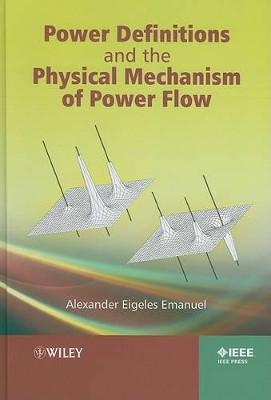
Professor Emanuel uses clear presentation to compare and facilitate understanding of two seminal standards, The IEEE Std. 1459 and The DIN 40110-2:2002-11. Through critical analysis of the most important and recent theories and review of basic concepts, a highly accessible guide to the essence of the standards is presented.
About the Author
Professor Alexander Eigeles Emanuel, Electrical and Computer Engineering, Worcester Polytechnic Institute, USA
Professor Emanuel has been working in the power field for around 45 years and he is currently Chairman of the Working Group that is responsible for the IEEE Std. 1459-2000. Founder of the International Conference on Harmonics and Power Quality, much of his groundbreaking work focuses on the effects of voltage and current waveform distortions on electrical systems.
After holding engineering posts in Israel and Romania, Professor Emanuel joined Worcester Polytechnic Institute in 1974. In 2008 he received the Chairman's Exemplary Faculty Prize from the institute, awarded for outstanding teaching and research. Besides this, he has also won the Board of Trustee's award, the 1998 R.H. Lee award from the IEEE Industry Applicationns Society, and many others including the Power Systems Instrumentation and Measurement Award. An IEEE Life Fellow, Professor Emanuel has been published in over 200 journal articals and recently contributed to Paulo Ribeiro's book Time-Varying Waveform Distortions in Power Systems, published by Wiley in 2009.
Reviews
Book Information
ISBN 9780470660744
Author Alexander Eigeles Emanuel
Format Hardback
Page Count 280
Imprint Wiley-IEEE Press
Publisher John Wiley & Sons Inc
Weight(grams) 640g
Dimensions(mm) 252mm * 175mm * 21mm
Key features:
- Explains the physical mechanism of energy flow under different conditions: single- and three-phase, sinusoidal and nonsinusoidal, balanced and unbalanced systems
- Starts at an elementary level and becomes more complex, with six core chapters and six appendices to clarify the mathematical aspects
- Discusses and recommends power definitions that played a significant historical role in paving the road for the two standards
- Provides a number of original unsolved problems at the end of each chapter
- Introduces a new nonactive power; the Randomness power.
Power Definitions and the Physical Mechanism of Power Flow is useful for electrical engineers and consultants involved in energy and power quality. It is also helpful to engineers dealing with energy flow quantification, design and manufacturing of metering instrumentation; consultants working with regulations related to renewable energy courses and the smart grid; and electric utility planning and operation engineers dealing with energy bill structure. The text is also relevant to university researchers, professors, and advanced students in power systems, power quality and energy related courses.
About the Author
Professor Alexander Eigeles Emanuel, Electrical and Computer Engineering, Worcester Polytechnic Institute, USA
Professor Emanuel has been working in the power field for around 45 years and he is currently Chairman of the Working Group that is responsible for the IEEE Std. 1459-2000. Founder of the International Conference on Harmonics and Power Quality, much of his groundbreaking work focuses on the effects of voltage and current waveform distortions on electrical systems.
After holding engineering posts in Israel and Romania, Professor Emanuel joined Worcester Polytechnic Institute in 1974. In 2008 he received the Chairman's Exemplary Faculty Prize from the institute, awarded for outstanding teaching and research. Besides this, he has also won the Board of Trustee's award, the 1998 R.H. Lee award from the IEEE Industry Applicationns Society, and many others including the Power Systems Instrumentation and Measurement Award. An IEEE Life Fellow, Professor Emanuel has been published in over 200 journal articals and recently contributed to Paulo Ribeiro's book Time-Varying Waveform Distortions in Power Systems, published by Wiley in 2009.
Reviews
Book Information
ISBN 9780470660744
Author Alexander Eigeles Emanuel
Format Hardback
Page Count 280
Imprint Wiley-IEEE Press
Publisher John Wiley & Sons Inc
Weight(grams) 640g
Dimensions(mm) 252mm * 175mm * 21mm