

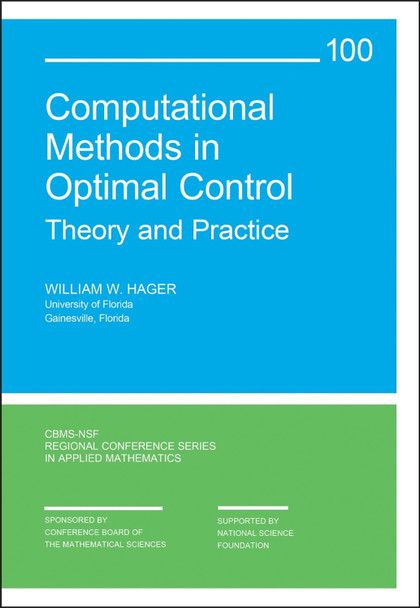

Description
Using material from many different sources in a systematic and unified way, this self-contained book provides both rigorous mathematical theory and practical numerical insights while developing a framework for determining the convergence rate of discrete approximations to optimal control problems. Elements of the framework include the reference point, the truncation error, and a stability theory for the linearized first-order optimality conditions.
Within this framework, the discretized control problem has a stationary point whose distance to the reference point is bounded in terms of the truncation error. The theory applies to a broad range of discretizations and provides completely new insights into the convergence theory for discrete approximations in optimal control, including the relationship between orthogonal collocation and Runge-Kutta methods.
Throughout the book, derivatives associated with the discretized control problem are expressed in terms of a back-propagated costate. In particular, the objective derivative of a bang-bang or singular control problem with respect to a switch point of the control are obtained, which leads to the efficient solution of a class of nonsmooth control problems using a gradient-based optimizer.
About the Author
William W. Hager is a Distinguished Professor of Mathematics at the University of Florida and co-director of the Center for Applied Optimization. He has held positions at the University of South Florida, Carnegie Mellon University, and Penn State University. He is a Fellow of the Society for Industrial and Applied Mathematics. His research has focused on a convergence analysis for discrete approximations to problems in optimal control, and he has worked on the development of algorithms for solving the large sparse optimization problems that arise from the discretization of optimal control problems. He has also conducted research relating to the charge structure in thunderstorms. His estimator CONDEST for the 1-norm condition number of a matrix can be found in MATLAB.
Book Information
ISBN 9781611978254
Author William W. Hager
Format Paperback
Page Count 277
Imprint Society for Industrial & Applied Mathematics,U.S.
Publisher Society for Industrial & Applied Mathematics,U.S.
Within this framework, the discretized control problem has a stationary point whose distance to the reference point is bounded in terms of the truncation error. The theory applies to a broad range of discretizations and provides completely new insights into the convergence theory for discrete approximations in optimal control, including the relationship between orthogonal collocation and Runge-Kutta methods.
Throughout the book, derivatives associated with the discretized control problem are expressed in terms of a back-propagated costate. In particular, the objective derivative of a bang-bang or singular control problem with respect to a switch point of the control are obtained, which leads to the efficient solution of a class of nonsmooth control problems using a gradient-based optimizer.
About the Author
William W. Hager is a Distinguished Professor of Mathematics at the University of Florida and co-director of the Center for Applied Optimization. He has held positions at the University of South Florida, Carnegie Mellon University, and Penn State University. He is a Fellow of the Society for Industrial and Applied Mathematics. His research has focused on a convergence analysis for discrete approximations to problems in optimal control, and he has worked on the development of algorithms for solving the large sparse optimization problems that arise from the discretization of optimal control problems. He has also conducted research relating to the charge structure in thunderstorms. His estimator CONDEST for the 1-norm condition number of a matrix can be found in MATLAB.
Book Information
ISBN 9781611978254
Author William W. Hager
Format Paperback
Page Count 277
Imprint Society for Industrial & Applied Mathematics,U.S.
Publisher Society for Industrial & Applied Mathematics,U.S.


