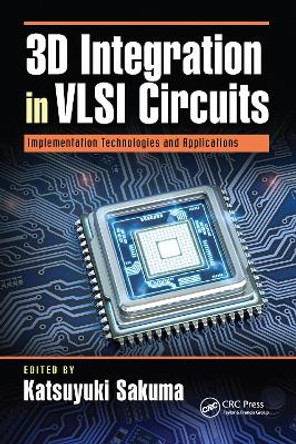



Description
Three-dimensional (3D) integration is identified as a possible avenue for continuous performance growth in integrated circuits (IC) as the conventional scaling approach is faced with unprecedented challenges in fundamental and economic limits. Wafer level 3D IC can take several forms, and they usually include a stack of several thinned IC layers that are vertically bonded and interconnected by through silicon via TSV.
There is a long string of benefits that one can derive from 3D IC implementation such as form factor, density multiplication, improved delay and power, enhanced bandwidth, and heterogeneous integration. This book presents contributions by key researchers in this field, covering motivations, technology platforms, applications, and other design issues.
Reviews
"3D integration is expected to deliver performance improvement and functional enhancement in future integrated circuits and systems. This book covers a wide range of 3D integration topics authored by an impressive selection of experts. This is a great reference source for everyone following this promising technology."
-Prof. L. Rafael Reif - Provost and Maseeh Professor of Emerging Technology, MIT, USA
"3D integration is expected to deliver performance improvement and functional enhancement in future integrated circuits and systems. This book covers a wide range of 3D integration topics authored by an impressive selection of experts. This is a great reference source for everyone following this promising technology."
-Prof. L. Rafael Reif - Provost and Maseeh Professor of Emerging Technology, MIT, USA
Book Information
ISBN 9789814303811
Author Chuan Seng Tan
Format Hardback
Page Count 378
Imprint Pan Stanford Publishing Pte Ltd
Publisher Pan Stanford Publishing Pte Ltd
Weight(grams) 636g