

Description
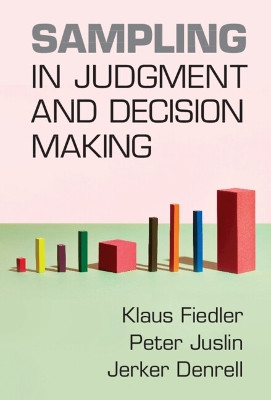
Sampling approaches to judgment and decision making are distinct from traditional accounts in psychology and neuroscience. While these traditional accounts focus on limitations of the human mind as a major source of bounded rationality, the sampling approach originates in a broader cognitive-ecological perspective. It starts from the fundamental assumption that in order to understand intra-psychic cognitive processes one first has to understand the distributions of, and the biases built into, the environmental information that provides input to all cognitive processes. Both the biases and restriction, but also the assets and capacities, of the human mind often reflect, to a considerable degree, the irrational and rational features of the information environment and its manifestations in the literature, the Internet, and collective memory. Sampling approaches to judgment and decision making constitute a prime example of theory-driven research that promises to help behavioral scientists cope with the challenges of replicability and practical usefulness.
An exploration of how statistical sampling principles impose theoretical constraints and enable novel insights on judgments and decisions.
About the Author
Klaus Fiedler is a Full Professor at Heidelberg University, Germany. He is a member of the German National Academy of Sciences Leopoldina, and a recipient of several science awards. Currently, he is Chief Editor of Perspectives on Psychological Science. His recent research has concentrated on judgment and decision making from a cognitive-ecological perspective. Peter Juslin is Professor of Psychology at Uppsala University, Sweden, and a member of the Royal Swedish Academy of Sciences. His research primarily concerns judgment and decision making. He has published extensively in prominent psychology journals on topics related to subjective probability judgment, overconfidence, multiple-cue judgment, and risky decision making. Jerker Denrell is Professor of Behavioral Science at Warwick Business School, University of Warwick, UK. He previously held positions at University of Oxford, UK and Stanford University, USA. His work focuses on how the biased experiences available to people lead to systematic biases in choices and judgment. He has published numerous articles in Science, PNAS, and Psychological Review.
Reviews
'Inferences depend heavily on what information is sampled. With chapters by leading sampling researchers, this book provides a fascinating overview of the innovative work done on this topic over recent decades. Sample these chapters to gain insights into how our minds work.' Robin Hogarth, Barcelona School of Economics and Universitat Pompeu Fabra, Spain
'There has been a revolution in cognitive and social psychology. The conventional view on rationality, which locates the causes of poor choices and judgments in the human mind, is being replaced with the view that the properties of informational samples go a long way to explain the successes and the failures of rational and irrational thinkers alike. A massive fundamental attribution error, committed by psychological science, is thus being corrected. This masterly volume, edited by Fiedler, Juslin, and Denrell, is a progress report and a manifesto of hard-nosed scientific progress.' Joachim I. Krueger, Brown University, USA
'This book makes a compelling case that we can greatly enrich our understanding of human judgment and decision making if we focus on how we sample information from environments that often seem deliberately designed to confuse or mislead us.' Barbara Mellers, University of Pennsylvania, USA
Book Information
ISBN 9781009009867
Author Klaus Fiedler
Format Paperback
Page Count 520
Imprint Cambridge University Press
Publisher Cambridge University Press
Weight(grams) 816g
Dimensions(mm) 229mm * 152mm * 29mm
An exploration of how statistical sampling principles impose theoretical constraints and enable novel insights on judgments and decisions.
About the Author
Klaus Fiedler is a Full Professor at Heidelberg University, Germany. He is a member of the German National Academy of Sciences Leopoldina, and a recipient of several science awards. Currently, he is Chief Editor of Perspectives on Psychological Science. His recent research has concentrated on judgment and decision making from a cognitive-ecological perspective. Peter Juslin is Professor of Psychology at Uppsala University, Sweden, and a member of the Royal Swedish Academy of Sciences. His research primarily concerns judgment and decision making. He has published extensively in prominent psychology journals on topics related to subjective probability judgment, overconfidence, multiple-cue judgment, and risky decision making. Jerker Denrell is Professor of Behavioral Science at Warwick Business School, University of Warwick, UK. He previously held positions at University of Oxford, UK and Stanford University, USA. His work focuses on how the biased experiences available to people lead to systematic biases in choices and judgment. He has published numerous articles in Science, PNAS, and Psychological Review.
Reviews
'Inferences depend heavily on what information is sampled. With chapters by leading sampling researchers, this book provides a fascinating overview of the innovative work done on this topic over recent decades. Sample these chapters to gain insights into how our minds work.' Robin Hogarth, Barcelona School of Economics and Universitat Pompeu Fabra, Spain
'There has been a revolution in cognitive and social psychology. The conventional view on rationality, which locates the causes of poor choices and judgments in the human mind, is being replaced with the view that the properties of informational samples go a long way to explain the successes and the failures of rational and irrational thinkers alike. A massive fundamental attribution error, committed by psychological science, is thus being corrected. This masterly volume, edited by Fiedler, Juslin, and Denrell, is a progress report and a manifesto of hard-nosed scientific progress.' Joachim I. Krueger, Brown University, USA
'This book makes a compelling case that we can greatly enrich our understanding of human judgment and decision making if we focus on how we sample information from environments that often seem deliberately designed to confuse or mislead us.' Barbara Mellers, University of Pennsylvania, USA
Book Information
ISBN 9781009009867
Author Klaus Fiedler
Format Paperback
Page Count 520
Imprint Cambridge University Press
Publisher Cambridge University Press
Weight(grams) 816g
Dimensions(mm) 229mm * 152mm * 29mm