

Description
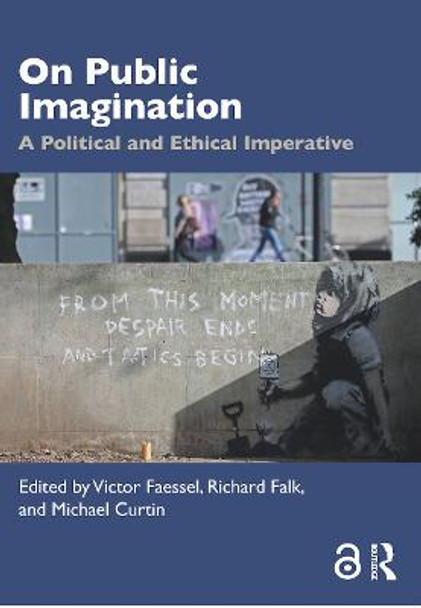
In this wide-ranging and multidisciplinary volume, leading scholars, activists, journalists, and public figures deliberate about the creative and critical potential of public imagination in an era paradoxically marked by intensifying globalization and resurgent nationalism. Divided into five sections, these essays explore the social, political, and cultural role of imagination and civic engagement, offering cogent, ingenious reflections that stand in stark contrast to the often grim rhetoric of our era. Short and succinct, the essays engage with an interconnected ensemble of themes and issues while also providing insights into the specific geographical and social dynamics of each author's national or regional context.
- Part 1 introduces the reader to theoretical reflections on imagination and the public sphere;
- Part 2 illustrates dynamics of public imagination in a diverse set of cultural contexts;
- Part 3 reflects in various ways on the urgent need for a radically transformed public and civic imagination in the face of worldwide ecological crisis;
- Part 4 suggests new societal possibilities that are related to spiritual as well as politically revolutionary sources of inspiration;
- Part 5 explores characteristics of present and potentially emerging global society and the existing transnational framework that could provide resources for a more humane global order.
Erudite and thought-provoking, On Public Imagination makes a vital contribution to political thought, and is accessible to activists, students, and scholars alike.
Chapter 18 of this book is freely available as a downloadable Open Access PDF at http://www.taylorfrancis.com under a Creative Commons Attribution-Non Commercial-No Derivatives (CC-BY-NC-ND) 4.0 license.
About the Author
Victor Faessel is Associate Director of the Mellichamp Initiative on 21st Century Global Dynamics at the University of California, Santa Barbara. He is co-editor (with Richard Falk and Manoranjan Mohanty) of Exploring Emergent Global Thresholds: Towards 2030 (2017), and is managing editor of The Oxford Handbook of Global Studies (2018, Mark Juergensmeyer, Saskia Sassen, and Manfred Steger, eds.) as well as the four-volume Encyclopedia of Global Studies (2012, Helmut Anheier and Mark Juergensmeyer, eds.). He has been the general secretary of the Global Studies Consortium, a worldwide association of teaching programs, since its founding in 2007.
Richard Falk is Albert G. Milbank Professor of International Law and Practice, Emeritus at Princeton University, and is currently a Visiting Fellow at the Orfalea Center of Global and International Studies, University of California, Santa Barbara. He is the author or editor of numerous books, most recently Revisiting the Vietnam War (2017), Power Shift: The New Global Order (2017), Palestine's Horizon: Toward a Just Peace (2016), (Re)imagining Humane Global Governance (2014), and The Path to Zero: Dialogues on Nuclear Dangers, with David A. Krieger (2012). He is also the author of a book of poems, Waiting for Rainbows (2015).
Michael Curtin is the Duncan and Suzanne Mellichamp Chair and Distinguished Professor of Film and Media Studies at the University of California, Santa Barbara. His books include Precarious Creativity: Global Media, Local Labor (2016); Distribution Revolution: Conversations about the Digital Future of Film and Television (2014); Reorienting Global Communication: Indian and Chinese Media Beyond Borders (2010); and Playing to the World's Biggest Audience: The Globalization of Chinese Film and TV (2007).
Reviews
"Richard Falk, Victor Faessel and Michael Curtin have brought together a diverse set of authors for an in-depth examination of the importance of public imagination. This is a much needed angle into the larger debate about the decay of liberal democracy." - Saskia Sassen, Columbia University, author of Expulsions
"Confronting today's public challenges demands reason and benefits from a sense of history - but neither is a substitute for imagination. We need imagination both to understand what is going on and to decide how to respond. Without imagination our public debates are inanimate and our politics mere power struggles. This book brings 30 exciting perspectives on how to renew public imagination." - Craig Calhoun, University Professor of Social Sciences, Arizona State University
"Facing mounting global problems ranging from climate change to widening social inequality, our 21st-century world is in desperate need of collective action based on a pluralistic public imagination. This highly readable anthology presents the concise and innovative views of dozens of influential intellectuals on the critical role of an ethical imagination that cut across political, economic, and cultural divides. Highly recommended!" - Manfred B. Steger, Professor of Sociology, University of Hawai'i at Manoa and Global Professorial Fellow, Western Sydney University
Book Information
ISBN 9780367360610
Author Victor Faessel
Format Paperback
Page Count 132
Imprint Routledge
Publisher Taylor & Francis Ltd
Weight(grams) 308g