


Description
Agrawal brings environment and development studies, new institutional economics, and Foucauldian theories of power and subjectivity to bear on his ethnographical and historical research. He visited nearly forty villages in Kumaon, where he assessed the state of village forests, interviewed hundreds of Kumaonis, and examined local records. Drawing on his extensive fieldwork and archival research, he shows how decentralization strategies change relations between states and localities, community decision makers and common residents, and individuals and the environment. In exploring these changes and their significance, Agrawal establishes that theories of environmental politics are enriched by attention to the interconnections between power, knowledge, institutions, and subjectivities.
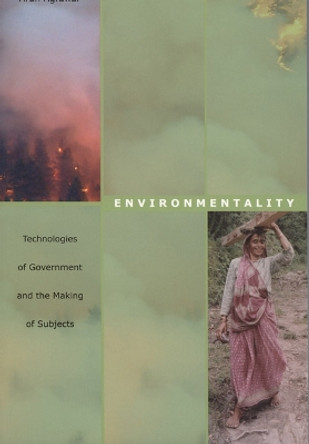
An investigation of environmental politics in light of Foucault's work, drawing on and extending work done in feminist environmentalism, political ecology, and common property scholarship, explains why villagers in the Kumaon Himalaya have begun to conserve forests.
About the Author
Arun Agrawal is Associate Professor in the School of Natural Resources and Environment at the University of Michigan. He is the author of Greener Pastures: Politics, Markets, and Community among a Migrant Pastoral People and a coeditor of Agrarian Environments: Resources, Representations, and Rule in India, both also published by Duke University Press.
Reviews
"Arun Agrawal achieves, in Environmentality, something of a breakthrough to new analytical territory where the binaries of state and society, structure and agency, public and private are transcended. He parlays the humble subject of community-based forestry and Foucault's concept of 'governmentality' into the makings of an original and subtle analysis of modernity and nature."-James C. Scott, Yale University
"Arun Agrawal has written an amazing book that draws on a very-long-term case study to make general lessons. He analyzes the development of the mentality of citizens and officials related to the environment in a particular setting undergoing major shifts from centralization to a form of decentralization. All of us can take some important lessons from this book about how people's mentalities change when they have power and knowledge to cope with a problem. That shift in knowledge and power took time and effort, but is one of the rare success stories of recent history."-Elinor Ostrom, coeditor of Seeing the Forest and the Trees: Human-Environment Interactions in Forest Ecosystems
"Environmentality offers readers in the fields of anthropology, environmental studies, and history a useful and interesting case study. . . . Environmentality is an excellent piece of scholarship, and a valuable addition to the fields of environmental anthropology and history, as well as to the general literature on colonial and postcolonial India." -- Sarah Strauss * American Anthropologist *
"[A] particularly useful and timely piece of scholarship as it attempts to transgress what are often distant and diverse literatures. This book helps to shed light on the connections between environmental regulation, practice and subjectivity. And in that way, this book illustrates the complexity and connectivity of environmental conflicts and struggles that are often overlooked by more limited or constrained analytical approaches. The book is very clearly organized and well written. . . ." -- Michael Mascarenhas * Rural Sociology *
"Interesting. . . . The strength of the book lies in its exploration of agency among the local populations and the serious treatment of the culture that environmental regulation affects. . . . This book offers an insightful critique of the assumptions that both the state and peasant resistance are monolithic . . . and provides a useful starting point to understand the phenomena of community forestry that governments are implementing around the world." -- Gregory Barton * American Historical Review *
Book Information
ISBN 9780822334927
Author Arun Agrawal
Format Paperback
Page Count 344
Imprint Duke University Press
Publisher Duke University Press
Weight(grams) 467g
![Environmentality: Technologies of Government and the Making of Subjects by Arun Agrawal 9780822334804 [USED COPY]](https://cdn11.bigcommerce.com/s-zkx5lhzlf8/images/stencil/444x444/products/8892962/9927597/9780822334804__86282.1752049728.jpg?c=1 "Environmentality: Technologies of Government and the Making of Subjects by Arun Agrawal 9780822334804 [USED COPY]")


