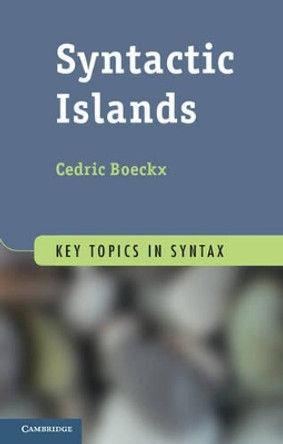


Description
The Movement Theory of Control (MTC) makes one major claim: that control relations in sentences like 'John wants to leave' are grammatically mediated by movement. This goes against the traditional view that such sentences involve not movement, but binding, and analogizes control to raising, albeit with one important distinction: whereas the target of movement in control structures is a theta position, in raising it is a non-theta position; however the grammatical procedures underlying the two constructions are the same. This book presents the main arguments for MTC and shows it to have many theoretical advantages, the biggest being that it reduces the kinds of grammatical operations that the grammar allows, an important advantage in a minimalist setting. It also addresses the main arguments against MTC, using examples from control shift, adjunct control, and the control structure of 'promise', showing MTC to be conceptually, theoretically, and empirically superior to other approaches.
Presents the main arguments for and against the Movement Theory of Control.
About the Author
Cedrick Boeckx is Research Professor at the Catalan Institute for Advanced Studies (ICREA), and a member of the Center for Theoretical Linguistics at the Universitat Autonoma de Barcelona. Norbert Hornstein is Professor in the Department of Linguistics at the University of Maryland, College Park. Jairo Nunes is Associate Professor at the University of Sao Paulo, Brazil.
Book Information
ISBN 9780521195454
Author Cedric Boeckx
Format Hardback
Page Count 274
Imprint Cambridge University Press
Publisher Cambridge University Press
Weight(grams) 600g
Dimensions(mm) 229mm * 155mm * 20mm
Presents the main arguments for and against the Movement Theory of Control.
About the Author
Cedrick Boeckx is Research Professor at the Catalan Institute for Advanced Studies (ICREA), and a member of the Center for Theoretical Linguistics at the Universitat Autonoma de Barcelona. Norbert Hornstein is Professor in the Department of Linguistics at the University of Maryland, College Park. Jairo Nunes is Associate Professor at the University of Sao Paulo, Brazil.
Book Information
ISBN 9780521195454
Author Cedric Boeckx
Format Hardback
Page Count 274
Imprint Cambridge University Press
Publisher Cambridge University Press
Weight(grams) 600g
Dimensions(mm) 229mm * 155mm * 20mm